In my previous post, I discussed a possible interpretation of Gandalf’s words to Bilbo at the end of The Hobbit: “You don’t really suppose, do you, that all your adventure and escapes were managed by mere luck, just for your sole benefit?“ In that post, I argued that Gandalf was here referring the higher idea of Providence, the secret workings of God, which only appear on the ground as luck or good fortune. In this post, I will take another approach to understanding Gandalf’s words.
* * *
If Gandalf’s words to chide Bilbo for thinking that luck was the cause of his successes, then what exactly does Gandalf thing was the cause of that success? Luck has the appearance of randomness, unpredictability, even arbitrariness about it. Culturally, we have expressions like “You make your own luck” to indicate that there is something more going on. At the very least, you have got to put yourself in the situation where luck can happen.
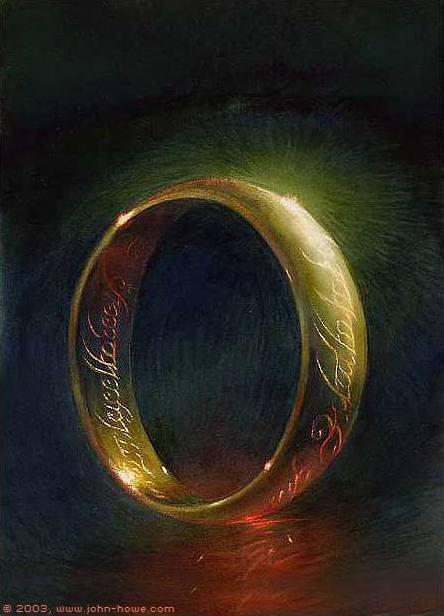
"The One Ring" by John HoweBut there are obviously some forms of luck that are totally outside of our control, like the luck of our births—though there we are essentially living off the luck (or bad luck) of our parents. Needless to say, for us in the modern world, luck feels cheep and unearned, and such phrases as “You make your own luck” are often shared more to judge the unlucky than to inspire.
So Gandalf’s words about luck can be read from a high angle (Providence) but they can also be read from a low angle (Make your own luck). These readings are not mutually exclusive, by the way, as I hope to make clear below.
Bilbo thinks he’s been lucky, fortunate, the beneficiary of chance. Gandalf says, No, it was you. One of the things Bilbo learns early on, maybe not quite as early as the scene with the trolls but definitely by the scene with Gollum, is that he has to be a man (or hobbit) of action.
Gandalf saves them from the trolls by taking decisive action in the face of danger. Was Gandalf lucky that it was near dawn rather than early in the evening? Sure. I’m not sure even he could have kept the trolls arguing for many hours on end. But the point is that by acting, Gandalf created the situation by which luck or timing could affect success.
Bilbo learns this for the first time in his dealings with Gollum. I think it hard to argue that the finding of the Ring is anything but Luck of the highest, most Providential kind—especially since Gandalf says as much to Frodo and especially, too, given the extreme unlikelihood that Bilbo would just happen to land, in an enormous cave network and in total darkness, right next to the Ring.
But the rest of Bilbo’s scrape with Gollum is really all Bilbo. Even the point at which he slips on the Ring for the first time it is because of Bilbo’s action that he escapes Gollum in the dark tunnels. In hearing Gollum screaming about his birthday present and what Bilbo might have in his pocketses, Bilbo reaches into his pocket in thought. What exactly do I have in my pocket? he is thinking, and the Ring slips onto his finger.

"Riddle Game" by Ted NasmithThis is not a heroic choice to act. It is not like the later encounters with the Spiders or, even more tellingly, in the Elf-caves. But that is not the point. The point is that had Bilbo not acted, had he not been aware and thinking about what Gollum was saying—if he had only been fleeing in complete terror—Bilbo would not have learned (then) what the Ring was capable of. And let’s face it, if Bilbo had not reached into his pocket when he did, he would have been Gollum’s supper that evening and the wretch would have recovered his precious from the hobbit’s pocket.
But I mentioned the Elf-caves: the sequence of events that leads to the dwarves’ escape, the sheer number of things that have to go just right, is staggering. Elves, who never get drunk, have to get drunk. There have to be empty barrels enough to fit all the dwarves. Bilbo has to get all thirteen dwarves—not invisible—through the Elf-caves to the cellar, and we have no idea just how large this network of caves really is. He has to get everyone packet safely away. The elves have to be just lazy or obedient or bored or un-curious enough to not open the barrels when they seem certain they aren’t empty. And all of this has to happen before the drunken elves wake up again.
The amount of luck on display here is enough to make one think Tolkien a hack writer, or to make one dismiss this all as nonsense. But Bilbo succeeds only because he decides to act. If he doesn’t act, then there is no chance for luck to work in his favour.
One could go on and on in this vein as the company approaches the mountain, and after Smaug’s death, and heading into the Battle of Five Armies, but I think the point is made.
So I will come back to the question of “either/or” or “both/and.” Is the luck of Bilbo Providence or personal action or both at the same time? The plain truth is that it is clearly both. It’s certainly not neither.
There is a kind of synergy happening here, a concept very much at the heart of Orthodox and Catholic understanding of salvation. Synergy is the working together of two parties to accomplish a goal. This does not mean that both parties contribute equally: Bilbo’s “fortunes” change precisely when he finds the Ring, a stroke of luck he had nothing to do with. Though even there, we can find some small amount of synergy: had Bilbo not gone on the adventure to begin with, he would never have found the Ring (yes, Gandalf pushed him out the door, but there were plenty of chances for him to turn back). And he sure makes good use of the Ring from then on and “creates” much of his luck in the future.
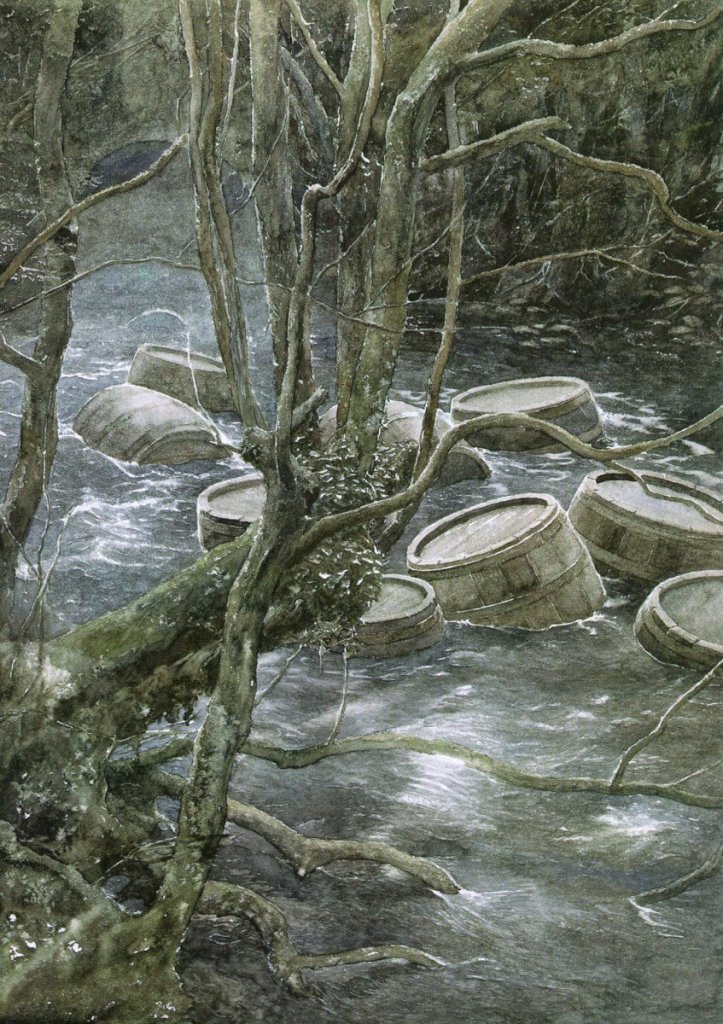
"Barrels out of Bond" by Alan LeeThere is a balance happening here. Return to the Elf-caves: That the elf guards sleep long enough for Bilbo to get all the dwarves stowed away is lucky. And it is not of Bilbo’s doing. It is, therefore, on the Providence side of things. But the Providence only mattered precisely because Bilbo had chosen to act in the first place.
Having just taught through this novel, I can report that my students were rather dissatisfied with the seemingly luck-controlled nature of Bilbo’s victories. When I asked them to write about what Gandalf meant by saying that it wasn’t just luck, most students argued that Gandalf was suggesting that Bilbo was more heroic than he realised. This is definitely true, but it is not completely true. Materialists that they are, none of them wrote about the possibility that Providence (or God, if you will) was behind it all. (That truth, though, does rely somewhat on the full, finished picture of the Lord of the Rings to really understand.)
The complete picture is that Bilbo had help, help that would not have mattered or have been received had Bilbo himself not been prepared to act. Bilbo’s successes—much like Frodo’s after him—came from the synergy of the human and Divine.
* * *
Having reached this point, I think I should say a few words about the last bit of Gandalf’s question: “just for your sole benefit?” But that will have to wait for another post next week.
 Something Tookish
Leave a comment