The opening chapters of Book Six, the second part of Return of the King, have got to be some of the most oppressive and depressing pages I have ever read. Chapter Two especially, “The Land of Shadow,” is just overwhelming in the dreariness and bleakness and sameness of the landscape.

"Across Gorgoroth" by Ted NasmithBut there is a section of this chapter that I also love deeply and which seems like the best metaphor of psychiatry and counselling that I have ever read. In the Land of Shadow, Frodo and Sam are trudging on, worn out and increasingly losing hope despite how near they are to their goal. Isn’t that often the case?
They are fleeing pursuers by heading north in Mordor rather than across Gorgoroth towards the Mountain of Fire. It is nearing morning and the hobbits stop for a breakfast of lembas, itself this powerful symbol of hope in a land where nothing grows that they can eat. There is a bit of a dawn, and then a little ways on, they discover a small trickle of water, enough for both of them to drink.
Sam remarks, “If I ever see the Lady again, I will tell her! Light and now water!” Two completely unlooked for good things in the Land of Shadow: a bit of natural light to see by and some water to slake their thirst. The light is not very bright—no more than a grey dusk—and the water is not the best—it had an unpleasant taste, at once bitter and oily—but it doesn’t matter. These are enough to sustain them for a while.
What’s interesting is that Sam wants to tell Galadriel of these things, miracles almost. It is no wonder in that dark, dark land that Sam should feel a dim grey dawn and some bitter water worthy of Galadriel’s knowing, for they must seem much nearer in kind to her brightness when in such a deep darkness as Mordor.
They go on and come into a dried riverbed, but within it there are more little trickles of water from the rocks collecting into little pools. And the narrator says this:
Upon its outer marches under the westward mountains Mordor was a dying land, but it was not yet dead. And here things still grew, harsh, twisted, bitter, struggling for life.
The folk of Middle-earth are so accustomed to thinking of Mordor as a land of death, as the Underworld even, that the thought of life in that place is foreign. But these images remind us that life fights. It is only humans, ironically the very beings in the world capable of hope, who despair of life and give up.
In that ravine, hidden from all eyes, the hobbits find a hole where they can curl up to sleep. Sam has to keep watch, and so he crawls out from their hiding place and looks out:
The land seemed full of creaking and cracking and sly noises, but there was no sound of voice or of foot. Far above the Ephel Duath in the West the night-sky was still dim and pale. There, peeping among the cloud-wrack above a dark tor high up in the mountains, Sam saw a white star twinkle for a while. The beauty of it smote his heart, as he looked up out of the forsaken land, and hope returned to him. For like a shaft, clear and cold, the thought pierced him that in the end the Shadow was only a small and passing thing: there was light and high beauty for ever beyond its reach. His song in the Tower had been defiance rather than hope; for then he was thinking of himself. Now, for a moment, his own fate, and even his master’s, ceased to trouble him. He crawled back into the brambles and laid himself by Frodo’s side, and putting away all fear he cast himself into a deep untroubled sleep.
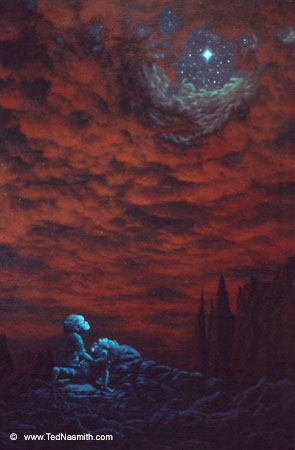
"Sam's Revelation" by Ted NasmithAs I said, I think this is a fantastic metaphor for what psychiatry and counselling and spiritual direction seek to offer. It’s easy to be focused down, though even when looking down, Sam and Frodo see little signs of life in Mordor that ought to inspire hope.
But it is seeing the star far off where Sauron cannot touch it, ancient and beautiful and capable of outlasting any darkness in this temporal world, that Sam rediscovers hope. There are signs of life and hope down below, but Frodo and Sam can barely see them—or, if they do, the hope fades again all too quickly. But by looking up and out of the Land of Shadow, the Shadow of Death, Sam sees beauty and light, and he knows that no darkness, be it ever so powerful, is able to touch that.
And what happens when he sees the star? His own fate, and even his master’s, ceased to trouble him. He forgets about himself, forgets about the troubles they are suffering. None of those things matter in this moment. It strikes me that all therapy, of whatever sort, is about helping someone see a star shining above.
And the effect on Sam? He crawled back into the brambles and laid himself by Frodo’s side, and putting away all fear he cast himself into a deep untroubled sleep. In the middle of the most dangerous place on earth, Sam finds enough peace to be able to sleep.
Is he being reckless? If our minds are on the earth below, we might think so. But Sam lays down because he realises that in this moment, there is nothing he can do about their situation. That is not a defeatist attitude either. It is a deep realisation borne from a moment of revelation that something bigger and more powerful than Sauron is still out there, something that Sauron cannot darken.
It is the hope that has returned to him. Hope is not wishful thinking. It is a deep trust. He knows again, somehow, that Frodo will succeed in the quest. He doesn’t know how. But he realises that if he is going to be of any use to Frodo, then he needs to rest as well. He abandons the waking fear that would keep him from sleep to instead trust in the Powers of Good beyond.
When they wake up, Mordor is still there. The Mountain of Fire is still belching forth noxious fumes. There is still a war in Middle-earth.
But the star—though covered by cloud—is still there as well.
 Something Tookish
Leave a comment