This is part 2 of a series on Tolkien’s Letter 131, most of which is included in the preface materials of The Silmarillion. Read Part 1 here.
* * *
One of the more common claims about Tolkien when it comes to interpreting his writing is that he disliked Allegory. This claim has become such a truism that any attempt to interpret his work allegory is usually met with howls of disapproval—“Don’t you know that Tolkien hated allegory?!” Well, Tolkien addresses allegory in the next section of his letter, and this what today’s post will focus on, because I think his position is a lot more nuanced than is generally accepted. Here is the quote:
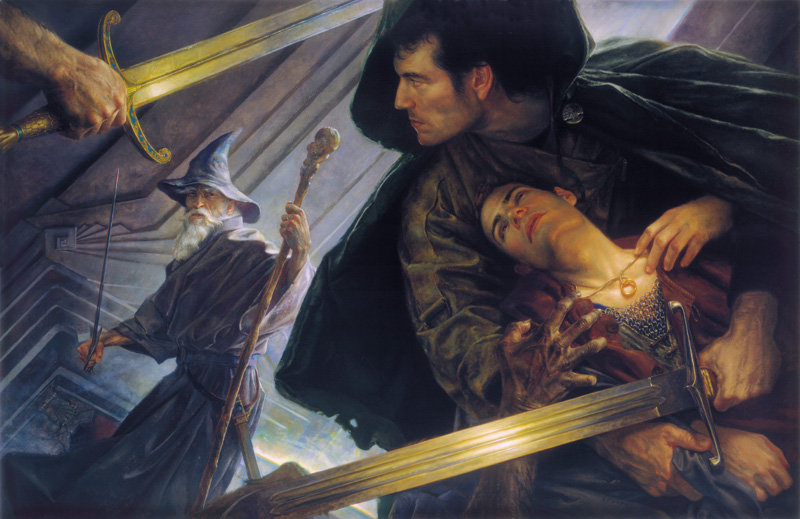
"The Lord of the Rings" by Donato GiancolaI dislike Allegory—the conscious and intentional allegory—yet any attempt to explain the purport of myth or fairytale must use allegorical language. (And, of course, the more ‘life’ a story has the more readily will it be susceptible of allegorical interpretations: while the better a deliberate allegory is made the more nearly will it be acceptable just as a story. Anyway all this stuff is mainly concerned with Fall, Mortality, and the Machine.
I include that last sentence in this extended quote precisely because there Tolkien seems to do the very thing he hates: present the scope of his stories in an allegorical mode. So before we get there, let’s begin by defining allegory in a few different ways so we are all on the same page. (As an English teacher, allegory is something that seems to give a lot of students a headache, being related to metaphor and symbol—difficult enough things already—but notably different as well.) For our purposes, I want to present three definitions:
- Modern Dictionary: A story, poem, or picture that can be interpreted to reveal a hidden meaning, typically a moral or political one (Google’s English Dictionary)
- Etymological: literally, speaking about something else (from Greek allegoria: from allos “another, different” + agoreuein “speak openly, speak in the assembly”); the Greek word allegoria meant in usage: figurative language, description of one thing under the image of another (Online Etymology Dictionary)
- Medieval Four Senses: The allegorical, what you should believe (From a Latin verse on reading instruction)—Dante defines it as the meaning derived from the things signified by the letters (and gives the example of the Biblical story of the Exodus as an allegory of our redemption accomplished through Christ)
Allegories are nearly as old as literature itself, existing in the works of Homer and the Scriptures, among other places. Perhaps the most famous allegory is Plato’s Cave. Contemporary examples include Animal Farm by George Orwell and The Lion, the Witch, and the Wardrobe by CS Lewis. It is these kinds of allegory that Tolkien seems not to have liked, the sort wherein to understand the story and fully appreciate it, one has to possess the “key” to the allegory. Napoleon in the pig in Animal Farm must be read as Russian dictator Joseph Stalin, and Aslan the lion in Lewis’ novels must be taken as Jesus. To read these characters otherwise—or without any deeper, symbolic meaning at all—is to miss the point of the story entirely.
Such stories have their uses, but there is a reason why they are few and far between and why they tend to be short—most of Christ’s parables are allegories of this straightforward sort. An extended, 300-page book in which all major characters and events are one-dimensional is rather boring to read. The power of such stories comes from their brevity and ability to point quickly at a deeper underlying reality. Too much of this stuff and you end up with Pilgrim’s Progress, which is frankly one of the worst novels written in the English language, suitable only as a devotional for a very specific sort of Christian.

"Aslan" by Michael HagueEtymologically, allegory presents a kind of puzzle: speaking about something other than what one is actually speaking about. This is tricky to do well, and even well-done it can lead to misunderstanding as we see in the Gospels where too often Christ’s words are not understood at all.
But it is in allegory, understand in the medieval world as a kind of application of the text, that Tolkien seems to find use for allegory as a tool. As he himself tells us, the more ‘life’ a story has the more readily will be susceptible of allegorical interpretations. In other words, intentional allegories are bad, but really good stories that ring true to life cannot help but invite allegorical interpretations.
And that brings us back to Tolkien’s feelings about the Arthurian legends that I was talking about in my previous post. In that post, I discussed Tolkien’s concern that the Arthurian presentation of faerie was just not satisfactory for a variety of reasons, but I mentioned also that Tolkien felt those tales failed as myth because they are involved in, and explicitly contain the Christian religion. The issue here is not exactly allegorical but it is adjacent to the problems Tolkien sees in allegory, and why he was not exactly in favour of his friend CS Lewis publishing The Lion, the Witch, and the Wardrobe. The moment a story becomes explicitly about Christianity, it is boxed into a creative corner, for suddenly there is no room to say anything “wrong” without opening the writer/teller to the charges of heresy.
Tolkien’s move, rather, was to create a mythology which can yet be accepted—well, shall we say baldly, by a mind that believes in the Blessed Trinity. He did not seek to portray Christian reality in his stories, only to create a story which was consistent with the Christian faith. There is a world of difference there. The moment Lewis decided to make Aslan an allegory of Jesus Christ, he was tied to certain narrative choices, certain personality traits, and certain actions. And the more bound a writer is in his allegory, the more one-dimensional the story and characters become. And that is never a good thing. What a writer gains in communicating a clear message, he loses in the art and subtlety of the craft.

"The Music of the Gods" by Kip RasmussenIn Lord of the Rings, Gandalf does some Christ things, but he is not neatly nor even mostly an allegory of Christ. And that is because Aragorn and Frodo also do Christ things, though not neatly and all the time. They operate more at the level of metaphor and symbol, which are momentary within a larger text, rather than as allegory, which consumes and overrides and entire text. In other words, for the space of a chapter, Aragorn may be doing something that is Christ-like, something that clearly echoes Christ on earth, but it is only for a chapter; Aslan is always being Christ, and so Lewis is not free to let Aslan do anything else. And, of course, this also means that Aslan, being the creation of a single writer, is always going to fail to completely capture that which he allegorises, as any human being is far more complex than a few hundred pages can capture.
So, returning to King Arthur, the concern with stories—myths especially—that are overtly Christian is that the layers of meaning are stripped away, and the story is now bound to a very specific mode. The story cannot explore and idea without, a priori, having decided what is good and bad, right and wrong, because it is being written as overtly Christian, and we all know what Christianity teaches. The stories are bound to a specific result, a specific outcome for every event and action.
But the medieval understanding of allegory that was developed in Late Antiquity for the reading of the Scriptures and for integrating pre-Christian literature into the universal story of Christianity, well, that is something that Tolkien seems to admit is always going to happen with good stories—and may even be desirable.
Which brings me back to the last sentence in that extended quote from the letter at the start of this post: Anyway all this stuff is mainly concerned with Fall, Mortality, and the Machine. Tolkien is not quite giving a “key” to unlock the meaning of the texts, but he is pointing towards application. And application is what we should believe, for it is from belief that action (which is application) arises. So when Tolkien says that his Silmarillion stories are about Fall, Mortality, and the Machine, what does he mean? Well, he very helpfully explains:
With Fall inevitably, and that motive occurs in several modes. With Mortality, especially as it affects art and the creative (or as I should say, sub-creative) desire which seems to have no biological function, and to be apart from the satisfactions of plain ordinary biological life, which which, in our world, it is indeed usually at strife. […] and so to the Machine (or Magic). By the last I intend all use of external plans or devices (apparatus) instead of developments of the inherent inner powers or talents.
That is a mouthful, so let’s unpack, because none of these is allegorical in the heavy-handed sense (conscious and intentional) but they do present application, the more medieval understanding of allegory.
(1) Fall: Tolkien seems to suggest (and there is more detail in the sentences that I excised from the quote about with the ellipsis) that all evil is preceded by a Fall, but that this Fall can take different forms and may be different person to person. There is obviously a reference being made here to the stories of Genesis (the Fall of Adam and Eve, the Fall of Cain, the Fall at the Tower of Babel, and so on), but it is not by means of direct allegory. Tolkien gives the example of possessiveness as a Fall; that is, the desire to possess something for one’s own rather than to share it when that is more appropriate is a Fall that leads to the commission of evil acts. So, to understand characters in Middle-earth, we have to understand their Fall. This is allegorical in the sense that there is a sideways glance at the Genesis stories, but it is not neatly and intentionally allegorical because, for example, Feanor’s fall in The Silmarillion is not a carbon copy of Adam’s, or Cain’s, or some other Fall.
(2) Mortality: Tolkien sees mortality—the lack of it as for the Elves or the possession of it for Humans—as a driving force (perhaps the driving force) of all art. What motivates people to create things that have no strict biological function of survival? Grappling with mortality is, for Tolkien, the motive, and so all stories treat of death in some way. This is not allegorical because there is no personification of Death, but the same concerns we have in the primary world are true in the same way in Middle-earth because his stories have ‘life’ in them and lots of it. Art springs from a love of the world, and that is not a bad thing in its proper proportions. We are beings of flesh and blood, not disembodied spirits who would be happy to exist without form in the spirit world. And this love of the world is made all the more potent because we are mortal. Again, not allegory, even though this idea permeates nearly every page of Tolkien’s work.

"The Mirror of Galadriel" by Alan Lee(3) The Machine: Tolkien gives us a gloss of “the Machine” as “Magic.” This is perhaps the nearest place Tolkien ever gets to the kind of allegory he claims to dislike, for we see obvious critiques of Machine and Magic in the books. By Machine/Magic, Tolkien means those devices by which we shortcut growth and development to arrive at something ahead of our own maturity. This is a classic Christian understanding of the Fall of Adam and Eve: the Knowledge of Good and Evil are not bad things, but the shortcut to that knowledge is bad—don’t eat the fruit of the tree, but grow in knowledge of Good and Evil over time. Shortcuts usually have disastrous results: contraception is a powerful recent example of a technology altering our humanity and not entirely for the better. In our present day, the race to General AI is a neat parallel, and those with an historical eye are right to be worried what this technology will mean for our humanity. But Tolkien admits that he has not been consistent in using the word “Magic” in his stories. Galadriel chides the Hobbits for using the same word (magic) for both what the Elves and the Enemy do. They are fundamentally different. In this case, the confusion in the Hobbits’ speech serves to point to our own confusion about “the Machine/Magic” in the real world.
Each of these three elements is closer in type to the allegory that Dante speaks of, the kind that looks at the story of the Exodus and applies it as a story of salvation in Christ. Tolkien is offering these three modes—I hesitate to call them themes or symbols—as a sort of “key” it is true, but it is not the shallow, narrow, one-to-one kind of the allegorical key he dislikes. These are modes of application: Look for the Fall, ask how Mortality motivates action, and learn from the misuse of Machine/Magic.
* * *
Continue reading in Part 3.
 Something Tookish
Leave a comment