This is part 3 of a series on Tolkien’s Letter 131, most of which is included in the preface materials of The Silmarillion. Read Part 1 and Part 2 here.
* * *
Tolkien’s stated goal behind the Ainur, the gods (or “angelic powers”) was to provide being of the same order of beauty, power, and majesty as the ‘gods’ of higher mythology, which can yet be accepted […] by a mind that believes in the Blessed Trinity.
I referred to this passage in my previous post regarding Allegory. Here, I want to focus on the relation between the Ainur and the “gods of higher mythology”—by which I suppose he means Greco-Roman and Norse mythology. In a biblical type of approach, Tolkien aims to set the records straight on the wrong beliefs of these pagan cultures. It is this backdrop to Middle-earth that makes certain sorts of Christians uncomfortable. I grew up in a particularly strict form of Baptist and Baptist-like churches, and both Tolkien and CS Lewis were forbidden as too pagan and too Catholic—which, for those sorts of folks, is one and the same thing really. But how is this different from what the Scriptures themselves do, taking pre-existing pagan stories and understanding them in the context of Israel’s God?
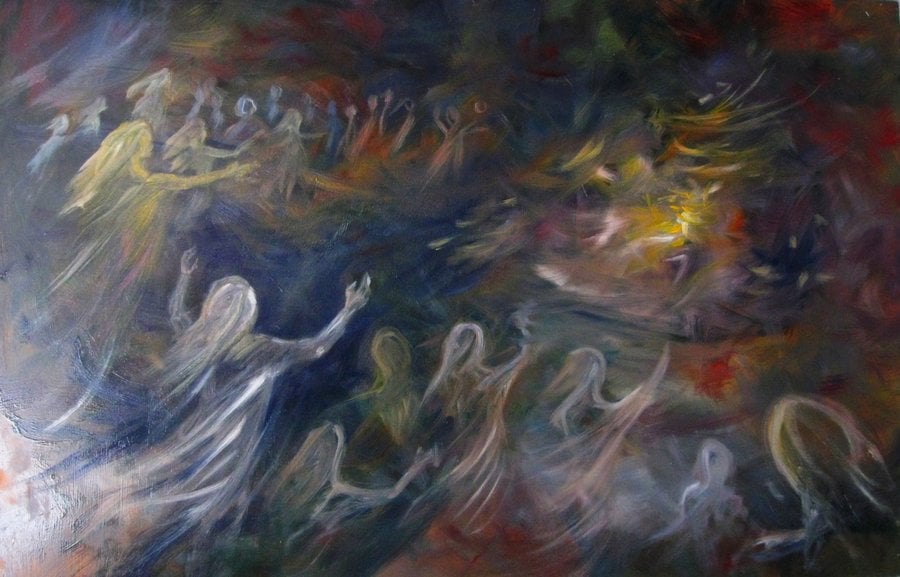
"Ainulindalë: Harmony" by Anna KuliszHere, too, we find one of those places where Tolkien seems to stray into areas that he claims to dislike, for in the entire legendarium, there are few places that are more clearly working from a defined Christian perspective than the narrative found in “Ainulindalë.” This is so obviously a place where Tolkien is seeking to fit the “gods of higher mythology” into the Christian understanding of God and the Angels that it again raises the question of how anyone can think that Tolkien was not (a) overly Christian in his writing and (b) actually writing a Christian epic.
In his letter, Tolkien goes on to say that the Ainur exercise delegated authority in their spheres of rule and government, not creation, making or re-making. This seems to stand in contrast with the way the creation narrative goes in “Ainulindalë”, wherein Ilúvatar invites the Ainur to join him in a song that is eventually revealed as part of the act of creation. I say “part” of because in the end it is still Ilúvatar who makes everything, saying, “those things that ye have sung, I will show them forth, that ye may see what ye have done.” Ilúvatar makes the songs of the Ainur into physical reality, but that is not to deny that the Ainur were in some sense involved.
So to say that the Ainur had no delegated authority in creation is I suppose technically correct, even though Ilúvatar invited participation in framing the blueprints of Arda, as it were. The “higher mythologies” all agree, however, that the gods had something to do with creation. And so the the balance Tolkien strikes between the Biblical Genesis narrative and pagan mythology is to show God’s love by including His creation in the act of creation. This ties thematically to one of Tolkien’s great concerns: sub-creation. That is a topic for another post—or series of posts—so I will merely mention the idea here and move on.
So the Ainur, the angels or gods, are intended as governors—authority in their spheres of rule and government—overseeing the vastness of creation. Classical Christianity—and Hebrew/Jewish religion for that matter—always understood a sort of hierarchy of being. It is not a matter merely of humanity and God: there are beings in between us with various amounts of authority.
Again, for a certain sort of Christian, this is suspect. God is sovereign and all-powerful. He does not need anyone to help Him order the spheres or govern the universe. That is not the reality of the Scriptures though, and so it is not the reality in Tolkien. Nor is it a matter of angelic beings serving as symbols, allegories, or codes for God’s omnipresence, as some modern Christians also see it, being uncomfortable with the idea of spirits just floating around out there in creation. Tolkien is attempting to put some meat on the bones of reality as described in the Scriptures.
His Ainur, the Valar particularly (being those Ainur who came and dwell within the Earth), are distinct personalities with power to move and act in their spheres of governance. They do not create; they are instead caretakers. But does God (Ilúvatar) need caretakers, doesn’t He just sustain everything Himself? No, He doesn’t need anything; and He is more than capable of taking care of everything Himself.
But that is not how He has chosen to do things. There is a vast difference between what one is capable of doing and what one chooses to do. Ilúvatar, drawing on the picture of God in the Scriptures, chooses to share what He has with others. And it is this choice to share that allows other wills to impact His creation. It is what allows for the possibility of evil.
Interestingly, Tolkien’s cosmogonical myth allows for evil almost at the moment that things begin to exist. Melkor sought to interweave matters of his own imagining that were not in accord with the theme of Ilúvatar. By choosing to share His creation, Ilúvatar chooses to allow others some influence over his creation. That influence can be exercised well or poorly; that which is poorly exercised, we call evil. Melkor tries more and more to exert his own will over the song, but in the end he can only do so much. And even that is only what Ilúvatar allows.

"Ainulindalë: Discord of Melkor" by Anna KuliszThere is a great difference between what is allowed and what is willed. God does not will evil, but He certainly allows it. Nevertheless, as is seen in the Music of the Ainur, that allowance is willed in such as way that, as Ilúvatar says eventually to Melkor, thou shalt see that no theme may be played that hath not its uttermost source in me, nor can any alter the music in my despite.
There are two ways of reading this:
(1) If all themes are ultimately sourced from Ilúvatar, then Ilúvatar becomes responsible for all things, including the evils of Melkor because Ilúvatar willed Melkor and thus willed everything Melkor did;
(2) All themes are sourced from Ilúvatar because all things were given being by Ilúvatar, who could see all ends before they began and decided that allowing the freedom to evil was worth the price to ensure the freedom to good.
I am starting to stray into the Problem of Evil here, and I do think this is something Tolkien seeks to address throughout his mythology.
For now, I want to wrap this up by coming back to Tolkien’s goal of creating a mythology that allows for gods like those of the Greeks and Norse but in a way that is palatable to Trinitarian Christians. The early Christians understood the gods of the cultures around them as being fallen angels or demons (which may or may not be exactly the same thing). In a way, Tolkien is attempting to show what an un-fallen Zeus or Poseidon, Odin or Thor might look like.
* * *
Continue reading in Part 4.
 Something Tookish
Leave a comment