Like many who smoke pipes in the modern world, I was drawn to them by the works of Tolkien. Neither of my parents were smokers of any sort, and while my stepfather smoked cigarettes during the first year or two that I knew him, he quit and has remained tobacco free ever since, almost thirty years now. He delighted in saying, “Smoking won’t send you to hell, but you’ll smell like you’ve been there!”
Anyhow, I’d like to look a few passages on pipe smoking in The Hobbit and The Lord of the Rings. Smoking plays an important role in both novels, and I drew attention to the role of tobacco while teaching the novel. A bit risky in a public school, perhaps, but the pipe serves as an important symbol, so I justified it as coming under the umbrella of literary studies. I’m going to make some light comments on a few of my favourite passages on smoking.
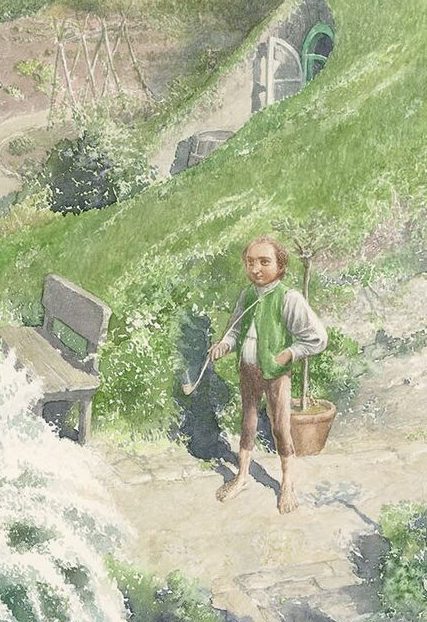
Detail, "Bilbo at Bag End" by Alan LeeAt any rate, let’s begin at the beginning: our introduction to Bilbo Baggins in chapter one of The Hobbit. By some curious chance one morning long ago in the quiet of the world, when there was less noice and more green, and the hobbits were still numerous and prosperous, and Bilbo Baggins was standing at his door after breakfast, smoking and enormous long wooden pipe that reached nearly down to his woolly toes (neatly brushed)—Gandalf came by.
The image of this long pipe is a bit ridiculous, but it sets the scene quite nicely. Bilbo is relaxing after breakfast and enjoying the morning. He is alone (one of the few times we see a character smoking alone), and suddenly Gandalf shows up. One of the very first things Bilbo says to the wizard, indeed before he even knows who this man is, is to sit down and share a pipe of tobacco. Thus even in this moment of solitary smoking, Bilbo looks for the chance to make this a communal act. I smoke alone most of the time, out on the back porch, but there is nothing like sitting around a table with a few friends who all have a pipe lit. It’s the next best fellowship to sharing a meal!
A bit further on after Bilbo’s home has been invaded by dwarves, Gandalf and Thorin sit down to smoke. When Bilbo enters the room, he found Thorin with his feet on the fender smoking a pipe. He was blowing the most enormous smoke-rings, and wherever he told one to go, it went—up the chimney, or behind the clock on the mantelpiece, or under the table, or round and round the ceiling; but wherever it went it was not quick enough to escape Gandalf. Pop! he sent a smaller smoke-ring from his short clay-pipe straight through each one of Thorin’s. Then Gandalf’s smoke-ring would go green and come back to hover over the wizard’s head. He had a cloud of them about him already, and in the dim light it made him look strange and sorcerous.
Two things jump out at me here: (1) Thorin like Gandalf has a voice of command, a curious detail that can get lost, and it cements for us the importance of this dwarf, even though he is at times not much of a leader; (2) the hovering green smoke around Gandalf makes him look sorcerous. “Sorcerous” is usually a term used negatively in the legendarium, and I suppose here that it is conveying the sense of danger that hovers around Gandalf (and, by extension, the adventure that is about to be unveiled). There is a connexion here, too, to the Prancing Pony at Bree when Frodo and co. first lay eyes on Strider: he is smoking a pipe and the impression is rather more of danger than friendship. But on a more mundane level, it is hard to resist the urge to blow smoke rings when seated with friends. Any successful ring is greeted with a round of “Hey-heys” and cheers! It’s simple uncorrupted fun.
Moving on in The Hobbit, Bilbo wakes up in the dark after having fallen from Dori’s shoulders in the goblin caves. At the very start of chapter five, after checking for bumps and bruises, we read: After some time he felt for his pipe. It was not broken, and that was something. Then he felt for his pouch, and there was some tobacco in it, and that was something more. Then he felt for matches and he could not find any at all, and that shattered his hopes completely.
Even though Bilbo doesn’t get to smoking at this point, the fact that he looks for his pipe to smoke is revealing. On one level I suppose this is all about calming nerves, since he is lost in the dark after all. But the emphasis on community that has surrounded smoking so far in the novel suggests that lighting a pipe here would serve as a symbolic act on Bilbo’s part to not feel so alone. Less about calming physical nerves than emotional ones, you could say. I am not a heavy smoker by any means—one or two pipes a week is all—but the times when I feel the urge to light a pipe are usually moments of stress and anxiety; not quiet alone in the dark, but alone in my mind.
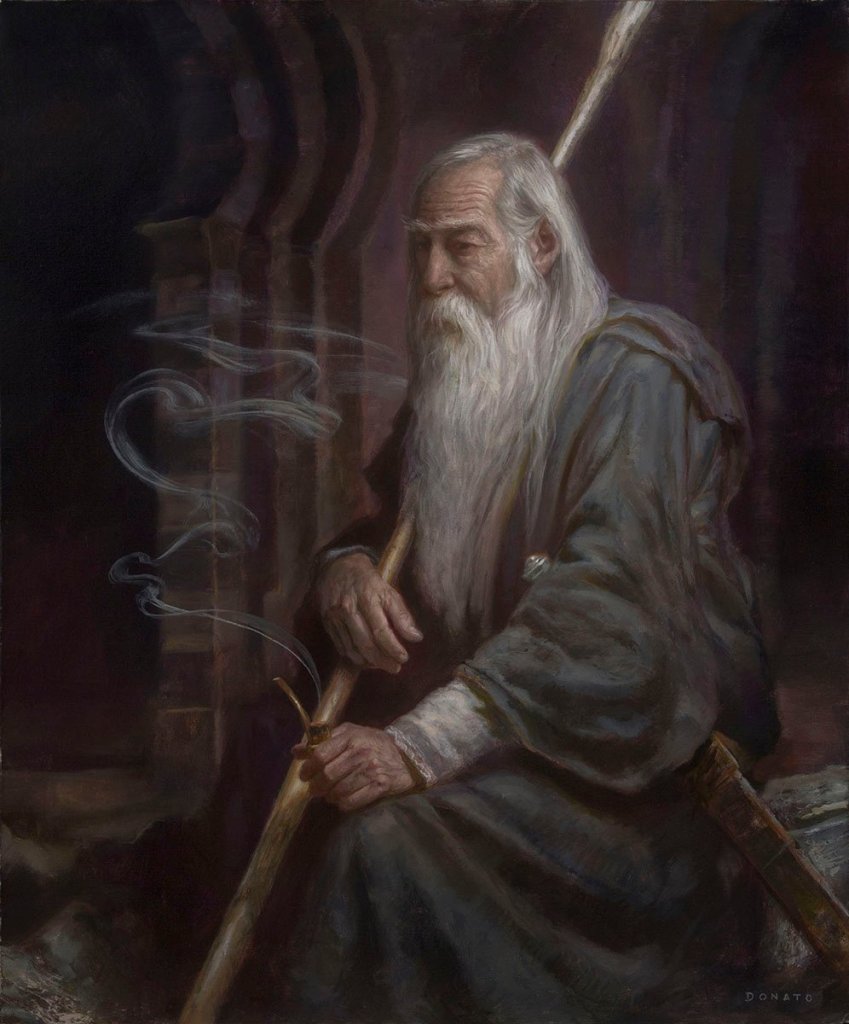
"Gandalf in Moria: The Three Doorways" by Donato GiancolaHopping across to The Lord of the Rings, while journeying through the Mines of Moria, the fellowship comes to a wide arch that opened to three passages. Not remembering the way, Gandalf leads them to a side room to rest for the night. As Gandalf relieves Pippin of the first watch, he mutters to himself, “I know what is the matter with me […] I need smoke! I have not tasted it since the morning before the snowstorm.” The last thing that Pippin saw, as sleep took him, was a dark glimpse of the old wizard huddled on the floor, shielding a glowing chip in his gnarled hands between his knees. The flicker for a moment showed his sharp nose, and the puff of smoke.
To solve the puzzle of which way to go, Gandalf turns to smoking. Another rare moment of someone smoking alone, but this time it is to help the wizard ruminate. Folks report using all sorts of distractions for their hands to help them think: whittling, knitting, doodling, smoking. It serves as a distraction for the body so the mind can do its work. Gandalf could sound like a bit of an addict who is missing his nicotine hit, but I think Tolkien is drawing on his experience (common to most of us who smoke pipes) that puffing away on a pipe often provides moments of clarity when puzzling over a problem.
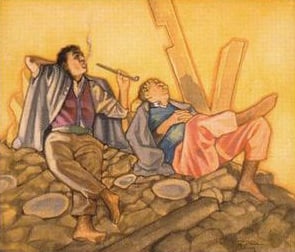
Later, in The Two Towers following the capture of Isengard by the Ents, Merry and Pippin engage in a little victory feast upon discovering a cache of “well-earned comforts”. It is in this state of post-celebration that Gandalf, Theoden, and company find them: There were bottles and bowls and platters laid beside them, as if they had just eaten well, and now rested from their labour. One seemed asleep; the other, with crossed legs and arms behind his head, leaned back against a broken rock and sent from his mouth long wisps and little rings of thin blue smoke.
Here, smoking serves as part of a celebration, a joyous moment following the victory over Saruman at Isengard. The way Merry lets “long wisps and little rings” out of his mouth highlights the leisureliness of the act. Unlike cigarette smoking, pipe smoking is a slow, meditative process. Sure, one can puff away nervously, but most folks normally take their time, slowly over the course of an hour, almost playing with the smoke. In this moment, the smoking serves visually as a kind of hedonic cherry-on-the-top after the hobbits have gorged themselves on food and wine. But it is also not hedonism for the sake of it. This is a joyous, festive occasion, and the pipe-smoking connects the hobbits (who have had a harrowing time of it) back to the Shire as a reminder of home in a foreign land. Again, the idea of fellowship around the pipe.
"Flotsam and Jetsam" by Zina SaundersThe final passage to look at (for now) is not one of smoking at all but of a discussion about smoking. While in the Houses of Healing (Return of the King) Merry says he doesn’t think he could ever smoke again. When asked why, he replies, He [Theoden] is dead. It has brought it all back to me. He said he was sorry he had never had a chance of talking herb-lore with me. Almost the last thing he ever said. I shan’t ever be able to smoke again without thinking of him, and that day, Pippin, when he rode up to Isengard and was so polite.” “Smoke then, and think of him!” said Aragorn.
This is a beautiful moment in which Merry gains new depths of meaning for an old habit. Aragorn supplies the wisdom here, that the fellowship of smoking extends beyond life itself. Through smoking—an act Merry admits that he and Theoden never got to do together nor talk about—the hobbit can commune with Theoden and bring him back to the present.
The thing that connects all of these moments is ritual. Smoking a pipe is a highly ritual act (something, ironically, that my priest cannot himself stand, having not the patience by his own admission for lighting, tamping, relighting, etc). The ritual of smoking transports characters out of the present, or frees their mind to contemplate, or joins people in fellowship. Like a really good ritual, it is capable of doing much more than just one thing at a time; it joins together many layers of meaning in a single, simple act.
 Something Tookish
Leave a comment