
From the very beginning of the legends of Middle-earth, there is evil. I suppose, rather, that it is better to say that soon after the beginning there is evil. The evil does not reside with Eru Ilúvatar at the beginning of all things but surfaces very quickly after the making of the Ainur. Melkor’s rebellion and clash with Ilúvatar and the other Ainur in the great Music of Creation is something I have discussed in my ongoing series on Tolkien’s Letter 131 (see Part 3). Today, I want to move more into the way Melkor’s fall into evil gets cemented in Middle-earth proper during the cosmogonical myth of the “Ainulindalë.”

"The Music of the Gods" by Kip RasmussenAs soon as Ilúvatar declares that the Song of the Ainur will take physical form, showing them a vision of what the Music will create, many of the spirits desire to go and dwell in this new world.
But when the Ainur had beheld this habitation in a vision and had seen the Children of Ilúvatar arise therein, then many of the most mighty among them bent all their thought and their desire towards that place. And of these Melkor was the chief, even as he was in the beginning greatest of the Ainur who took part in the Music. And he feigned, even to himself at first, that he desired to go thither and order all things for the good of the Children of Ilúvatar […] But he desired rather to subdue to his will both Elves and Men, envying the gifts with which Ilúvatar promised to endow them; and wished himself to have subjects and servants, and to be called Lord, and be a master over other wills.
Melkor’s desire to enter the world is not in itself bad. It is his motives that are evil. Immediately after this passage, Tolkien writes: But the other Ainur looked upon this habitation set within the vast spaces of the World which the Elves call Arda, the Earth; and their hearts rejoiced in light, and their eyes beholding many colours were filled with gladness.
So what is the problem here? It is not rule or kingship itself that is the problem. These, as we shall see, are the natural state of things. Rather it is the desire for rule and kingship that motivate Melkor’s evil. We are told several times in the “Ainulindalë” and the subsequent “Valaquenta” that Melkor is the greatest of the Ainur made by Ilúvatar. In him are a part in all the gifts given to the various Ainur. On one level—perhaps the least interesting thing I have to say here—it is Melkor’s pride that leads him to desire kingship. He is the greatest, the most powerful, the most beautiful, the most perfect. To his mind, it is natural that he should rule.
But his desire for rule presents two obvious problems: first, his desire to rule is specifically a desire to have subjects and servants; he does not want to share any of his power but wants to lord it over others. Second, the rule of Middle-earth has not been given to him (something that we shall see later).
In the Social Contract Theory of government (which I do not think Tolkien ascribed to, but go with me for a moment), Melkor’s “government” would be illegitimate, as it is a government of domination over others rather than for their flourishing, and because the governance has not been granted to the governor but rather seized by him. When seen in this light, we can see that the problem lies not in the mode of government but in the motive of the governor.
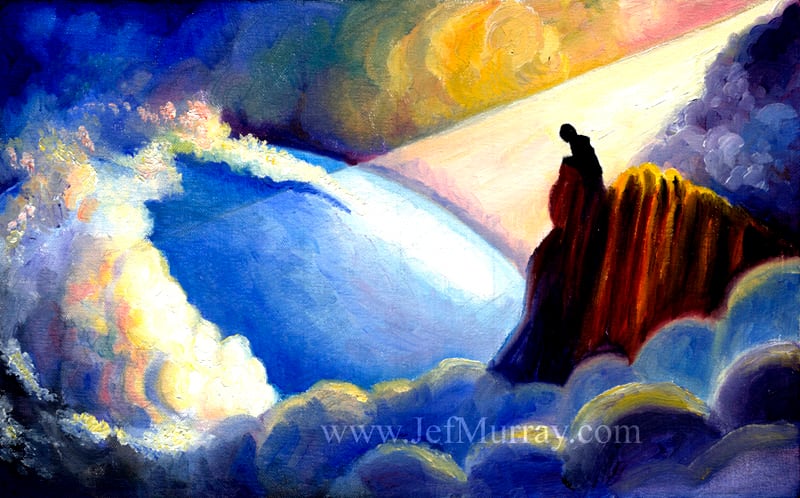
"And Melkor Coveted Arda" by Jef MurrayWhat is especially interesting is that Melkor feigns so well that he fools even himself at first: He feigned, even to himself at first, that he desired to go thither and order all things for the good of the Children of Ilúvatar. The World was being made for Elves and Men, not for the Ainur, and what moved those Ainur who wished to go was to be near to the Children of Ilúvatar, to make the world beautiful for them, and to see the mysteries of God play out. Melkor, who had been suitably chastened by now for his variant music during the Song of the Ainur, makes all the right noises this time—but the truth hides deep in his heart. It is a hard thing to lie to oneself. Lying to others is easy, but we cannot long hide the truth of our own motives from our own hearts. At best, this is a case of “fake it till you make it”; at worst, it is disingenuous and what the French Existentialist Jean Paul Sartre called “bad faith.” Lying to oneself, as Melkor does here, always ends with doing the thing we say we do not want to do because—well, obviously—because it is really what we want to do.
And what Melkor really wants to do is to make a kingdom for himself!
Melkor’s heart ultimately brings him into conflict with the other Ainur who enter the World, Manwë, Aulë, and Ulmo in particular. Of the three, Melkor is most like Aulë, whose skill and knowledge is described as being “scarce less than Melkor.” The key difference between Aulë and Melkor, however, lies once again in motive: the delight and pride of Aulë is in the deed of making, and in the thing made, and neither in possession nor in his own mastery; wherefore he gives and hoards not, and is free from care, passing ever on to some new work.
Aulë has pride, a word that often carries exclusively negative connotations, but it is here coupled with delight and explained as being a kind of joy in making fine things, in a skill well exercised. Such pride does not need to possess the thing made in order to value it. Instead, such pride is specifically directed towards the sharing of what is made. Aulë is not looking for praise either; the act of making is enough. And he is free from care, meaning he is not weighed down by worries that someone is going to come along and steal his creations. Such behaviour is what makes dragons not gods and saints.
The Silmarillion gives plenty of evidence that Melkor is a capable maker. He makes orcs, and trolls, and dragons, and a mighty fortress. Ilúvatar tells Ulmo that Melkor is responsible for the existence of snow and ice, fire and lava. He is a capable maker. And neither he nor the other Ainur create out of nothing; they all use pre-existing materials as sub-creators (as Tolkien calls the creative acts of Mankind). But Melkor’s creations are all twisted versions of something good, corrupted to give him slaves because he is afraid that no one would serve him freely!
In the “Valaquenta” story, Tolkien says of the relationship between Melkor and Aulë: Melkor was jealous of him, for Aulë was most like himself in thought and in powers; and there was long strife between them, in which Melkor ever marred or undid the works of Aulë, and Aulë great weary in repairing the tumults and disorders of Melkor.
Melkor’s pride extends into envy and jealousy, two related but quite different sins. Melkor is jealous in that he thinks that only he should have the abilities of making and shaping the earth. They should be his alone and not shared. He is envious in that, once he sees another make something, he desires it for himself to the harm of the previous owner. Worse still, he desires Aulë’s creations specifically so he can corrupt them. It is one thing for me to want the shiny thing you have and to take it from you for myself; it is quite a worse thing to then corrupt, tarnish, or mar that which I have stolen so that it is no good to anyone anymore.
In so many ways, Melkor is an uncomplicated villain. He has no grand schemes like the later schemes of Sauron. He is just a schoolyard bully, a spoiled toddler with the powers of a god.

"Morgoth and Sauron" by Ralph DamianiDespite what Melkor will do and become, Ilúvatar still thinks it better than the alternative to allow the Ainur into the World and to begin fashioning it. The alternative, of course, is non-existence. No Earth. No life. No Children of Ilúvatar. Life is always better than non-life, than nothingness.
And so Ilúvatar makes the World a reality, the song takes form, and he allows those Ainur who so wish to enter the world and to bring the vision of their Music to fruition. And in this work the chief part was taken by Manwë and Aulë and Ulmo; but Melkor too was there from the first, and he meddled in all that was done, turning it if he might to his own desires and purposes; and he kindled great fires. When therefore Earth was yet young and full of flame Melkor coveted it, and he said to the other Valar: ‘This shall be my own kingdom; and I name it unto myself!’
There is no more feigning here. Melkor makes his desire known directly to those he deems beneath him. Note that he did not speak this way in the presence of Ilúvatar, not after he had been put in his place by God who made him. But he knows that his power is greater than any of the Valar in Middle-earth, and so he thinks he can make demands. He demands lordship. It is not granted to him. He desires to take it.
In the “Valaquenta” again, we read of Manwë: Manwë is dearest to Ilúvatar and understands most clearly his purposes. He was appointed to be, in the fullness of time, the first of all Kings: lord of the realm of Arda and ruler of all that dwell therein.
The problem is not kingship, not with the form of government. Ilúvatar established that Arda would be a monarchy. Just as every depiction of God and Christ in the Scriptures is of a monarchy—just as God clearly intends for earthly nations, which follow the pattern of Heaven, to be monarchies. The problem is not with kingship but with how one becomes a king. Melkor grasps at rule; Manwë is given rule in the fullness of time.
The role of an earthly king is to be a reflection of God in the world. This is something that a president or governor or mayor cannot do because Heaven is not a democracy. Elected officials always have to pander to the people who elect them. However, this is also why “the divine right of kings” is a poor justification for monarchy, because kingship is given in the fulness of time. If one has to justify one’s leadership by claiming again and again that “God wills it,” then it’s probably not from God either.
We see something like this in Bard of Lake-town/Dale in The Hobbit. He is the rightful king of the Men of the North, but he does not grasp at it. And when he slays Smaug, he does not then declare that he is the king. The people declare him king, and even then he resists.
The same pattern repeats for Aragorn, the King of Gondor. True kings do not desire the power that belongs to them but they take it up in the fullness of time. Which is precisely what is wrong with a democratic system in which the power-hungry are encouraged to chase ever more power, feigning love and service to those they wish to rule over. A true king is neither a panderer to the people nor a tyrant. He does what needs to be done when it needs to be done and otherwise lets people get on with their lives, doing what he can to help them flourish. A true king is able to say to the people, “No, you do not need this.” A democratic politician is almost always forced to say, “Thy will be done, my people,” even if that will is to their destruction; he must do this or risk being voted out of office.

"Morgoth and the Silmarils" by Justin GerardMelkor is a usurper, corrupter, and tyrant. These are qualities of illegitimate leadership whether the government be a monarchy or democracy. Monarchy is no less legitimate than democracy; and democracy is no more legitimate than monarchy. As we see in Melkor, the desire of the ruler to have “subjects and servants” is the problem.
Christ shows a quite different way to rule, the way of a True King: And Jesus called them to him and said to them, “You know that those who are supposed to rule over the Gentiles lord it over them, and their great men exercise authority over them. But it shall not be so among you; but whoever would be great among you must be your servant, and whoever would be first among you must be slave of all. For the Son of man also came not to be served but to serve, and to give his life as a ransom for many.” (Mark 10:42-45 RSV-2CE).
Worldly rulers, like Melkor, “lord it over” their subjects. True leaders in God’s kingdom—and in The Silmarillion Manwë exemplifies this—are servants first. Servants do not care about plaudits or praise from those they serve. They do what they do because it is their job. A True King serves and in serving, leads.
 Something Tookish
Leave a comment