After an unintended and unforeseen hiatus, I am back. This is part 6 of a series on Tolkien’s Letter 131, most of which is included in the preface materials of The Silmarillion. Begin reading at Part 1 — or visit the previous post in this series.
* * *
At this point in his letter, Tolkien pivots to begin writing about the Second Age, the Age of Númenor. In many ways, this is the Age of Sauron too, who survived the end of the First Age and the exile of Melkor the Morgoth into the Void beyond the world. Indeed, most of Tolkien’s description of the Second Age in this letter deals with the various ways in which Sauron corrupted the world that had seemingly been saved from evil by the defeat of Morgoth.

"The Forging of the Rings" by Alan LeeThe history of Arda shifts focus from Middle-earth (Beleriand) where The Silmarillion had been set to the Island of Númenor. One of the first things Tolkien says on this point is that the Orcs and other monsters bred by the First Enemy are not wholly destroyed. So there is evil yet lingering in the world, Melkor has not left creation untouched.
It is at this point that Tolkien introduces the great villain of the Second Age: And there is Sauron. In the Silmarillion and Tales of the First Age Sauron was a being of Valinor perverted to the service of the Enemy and becoming his chief captain and servant. He repents in fear when the First Enemy is utterly defeated, but in the end does not do as was commanded, return to the judgement of the gods. He lingers in Middle-earth. Very slowly, beginning with fair motives: the reorganising and rehabilitation of the ruin of Middle-earth, ‘neglected by the gods’, he becomes a reincarnation of Evil, and a thing lusting for Complete Power — and so consumed ever more fiercely with hate (especially of gods and Elves).
There is a lot going on in those couple of sentences, but I’d like to touch on three things:
(1) Sauron began as a servant of Morgoth. In the “Valaquenta” chapter in The Silmarillion, Tolkien says of Sauron that he was only less evil than his master in that for long he served another and not himself. This is a very curious statement, suggesting that in subjecting our will to another, even an evil master, there is still some small sliver of good for we do not set ourselves up as the ultimate truth. However, Sauron began life as a servant of Aulë, the craftsman, and this is the source of Sauron’s great learning and knowledge. He is, in many ways, smarter and wiser than Morgoth his master. But Sauron’s choice of whom to serve (Melkor the Morgoth over Aulë) is the cause of his evil path. He joins himself to someone who leads him astray. We all have to follow someone. None of us is capable of being our own master. Not entirely. Whom do we serve?
(2) He repents but doesn’t follow through. Sauron’s repentance following the fall of Melkor may or may not have been genuine, even though it was out of fear. It may have been—likely was—of the sort that he was sorry and afraid to have been caught rather than repenting of having done bad things. Anyhow, he repents and is forgiven but rather than return to Valinor to do penance, he hides in Middle-earth. How much evil is caused by not following through on the penances we must do when we have done wrong? Rather than start over, Sauron soon picks up where he left off, indicating that his repentance was to save his own skin rather than genuine.
(3) His return begins slowly and with fair motives. We like to say that the road to hell is paved with good intentions. Even such 20th-century monsters as Hitler and Stalin acted from motives that in the most narrow sense could be good; they wanted their people to flourish following periods of extreme economic downturn. But these motives, good in themselves for leaders, were soon turned to evil in how they sought to implement the necessary changes. Motives are important, but they can often mask terrible acts. Consequences are equally—if not more—important and it is on these that we are judged.
Taken as a whole, these three facts about Sauron tell us an awful lot about Tolkien’s conception of evil—not the grand ultimate personifications of evil like Melkor the Morgoth but the more “humble” evils of humankind. Sauron becomes evil (again) through processes that, I think, any one of us humans could—and probably do—take on such a path. We align ourselves to the wrong masters; we repent to save our skins because we got caught and not because we are truly sorry; and we often end up doing bad things beginning with seemingly good motives.
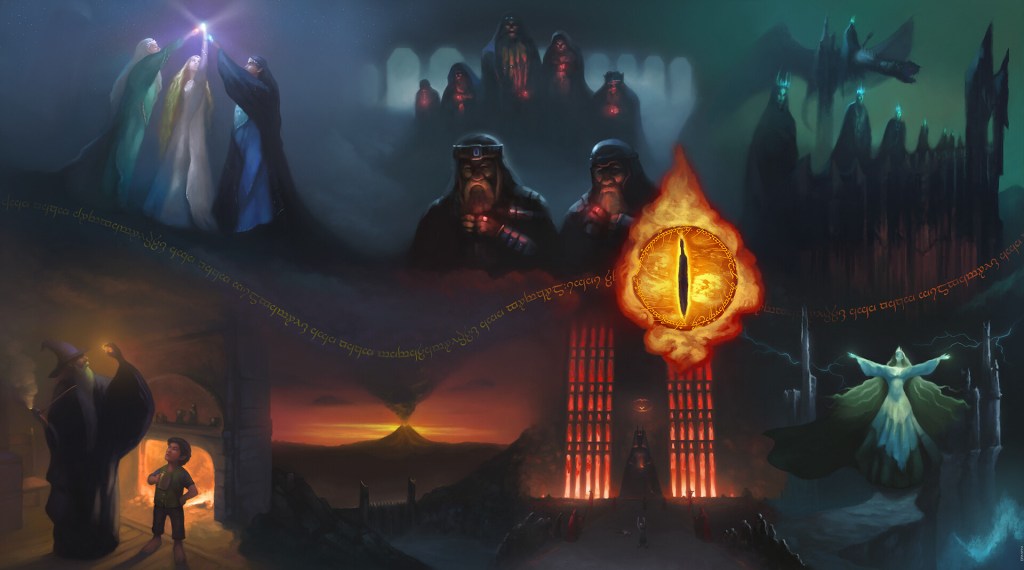
"Ring-verse" by Ralph DamianiTolkien considers the growth of Sauron as the new Dark Lord to be essential background for reading The Hobbit and The Lord of the Rings, and thus we arrive ultimately at the real reason Tolkien wrote this 10,000-word letter. He is seeking to justify his demand that the Silmarillion and Lord of the Rings be published simultaneously and together.
At the beginning of the Second Age, we learn of a second Fall of the Elves (after the first fall of Féanor in The Silmarillion), that is the desire of the Elves to remain in Middle-earth instead of returning to the West, to Valinor. He writes, They wanted the peace and bliss and perfect memory of ‘The West’, and yet to remain on the ordinary earth where their prestige as the highest people, above wild Elves, dwarves, and Men, was greater than at the bottom of the hierarchy of Valinor. They thus became obsessed with ‘fading.’
Having tasted of “Heaven,” the Elves choose to remain in the ordinary world. There is a warning here against having a foot in two places at once: either commit to the Heavenly realm or to the Earthly realm. St Paul’s warning about God spewing out lukewarm Christians comes to mind here. Why did the Elves choose to remain? Pride. They wanted to be at the top of the hierarchy of the ordinary world rather than at the bottom of the hierarchy of the Heavenly realm. How mad is that? But it is really in moments like this that we can understand what Tolkien meant in saying that his Elves essentially represent humans as much as the Men of Middle-earth do. Here we see our own tendencies to love the World, to not want to give up the good things of this Life in exchange for wholeheartedly grabbing onto the Good of Life to come.
Tolkien specifically calls this decision of the Elves a “fall,” and as we saw earlier in the letter (see Part 2 of this series), Tolkien considers “Falls” to be essential to storytelling, as it is through these openings that evils enter causing the conflicts that drive the plot. And what evil enters here? Is it not the obsession with “fading”? As a result of a kind of ennui or malaise, the Elves long for Valinor and are not satisfied with Middle-earth and yet they cling to this world and will not go to their Real Home.
This hanging on, this “fading”, is the very thing that Sauron uses to manipulate the Elves into the creation of the Rings of Power. Tolkien writes, Sauron found their weak point in suggesting that, helping one another, they could make Western Middle-earth as beautiful as Valinor. This was an attack on the gods, on the Valar, and it is through these machinations that Sauron convinced the Elves of Eregion to craft the Rings of Power, the chief power (of all the rings alike) was the prevention or slowing of decay, the preservation of what is desired or loves, or its semblance. The Rings were made precisely so that the Elves could hang onto this earthly home rather than go to the Heavenly home that they had been invited to.
Famously, of course, it is at this point that Sauron makes in secret the One Ring, the Ruling Ring, by which he hoped to ensnare Elves and Men and Dwarves. That he failed to ensnare the Elves was only because they realised their folly in time and so hid the rings and did not use them as intended. Sauron’s Ring was designed to control. Here is what Tolkien says of how it worked:
But to achieve this he had been obliged to let a great part of his own inherent power (a frequent and very significant motive in myth and fairy-story) pass into the one Ring. While he wore it, his power on earth was actually enhanced. But even if he did not wear it, that power existed and was in ‘rapport’ with himself: he was not ‘diminished’. Unless some other seized it and became possessed of it. If that happened, the new possessor could (if sufficiently strong and heroic by nature) challenge Sauron, become master of all that he had learned or done since making of the One Ring, and so overthrow him and usurp his place.

"The Forging the One" by Ted NasmithTolkien describes the Ring as a kind of technology, a way to amplify natural abilities. Is this not what our own human technologies are designed to do? A book amplifies human memory by essentially extending that memory outside of one’s head. The internet amplifies the ability of a book by making that memory space essentially infinite. A sword amplifies our physical ability to kill; an atom bomb amplifies the sword millions upon millions of times.
The Ring has a great strength for Sauron in that it allows him to continue to exist as long as the Ring exists. This is, of course, how he survives the three thousand years of the Third Age. But this strength is also a weakness, for it allows someone with the requisite strength to challenge Sauron if they come into possession of the Ring, and it allows for the total destruction of Sauron if the Ring can be unmade.
Gollum—Sméagol—was obviously not of requisite strength to claim the Ring as a new Dark Lord. It overpowered him instead. Frodo’s great strength lay precisely in his weakness and his humility in his weakness. Saruman lusted for the Ring so that he might challenge Sauron and become the new Dark Lord. Gandalf and Galadriel both resisted the Ring, denying it when offered, because they too could have challenged Sauron as the Ring turned all their will to evil.
Of the ring, Tolkien also says, Also so great was the Ring’s power of lust, that anyone who used it became mastered by it; it was beyond the strength of any will (even his own) to injure it, cast it away, or neglect it. So he thought.
Gandalf resists the Ring when offered not because he wouldn’t use it and so lose it (like Tom Bombadil might) but precisely because Gandalf knew he could not resist the urge to make use of it, and through him, though he sought to do good, the Ring would work great evil. We will discuss further down the road how exactly Frodo was able to resist the Ring’s power, but the key lies in his humility. Gandalf is suggesting that he would use it because he would believe that he could control it. Galadriel likewise would think she could control it. That is the curse of the powerful. But Frodo knew that it was beyond his ability to control, and this humility actually worked as a shield to protect him from most of its evil.
At any rate, Sauron’s motive in all of this was the establishment of an evil theocracy, for Sauron is also the god of his slaves. Thus in desiring to be a Dark Lord, the emphasis is on the “Lord” in its Christian/religious context. He wishes to set himself up in opposition to the Valar and to Ilúvatar. He wishes to be the god of this world, the god of Middle-earth.
As Tolkien begins to describe the history of Númenor in particular, we will see what forms this grasping at godhood takes for Sauron.
 Something Tookish
Leave a comment