
It is easy to forget that the Wizards, or Istari, of Tolkien’s works are a kind of lower-order angel. Then again, Christians love to point this out, so perhaps it’s not so easy to forget. In a passage that Christopher Tolkien dates to 1972, Tolkien writes, “We must assume that they [the Istari] were all Maiar, that is persons of the ‘angelic’ order, though not necessarily of the same rank.” I love the nature of Tolkien’s speculation here, as though he does not know the truth. But what I want to explore instead is the way that power veils itself, hiding its true nature.
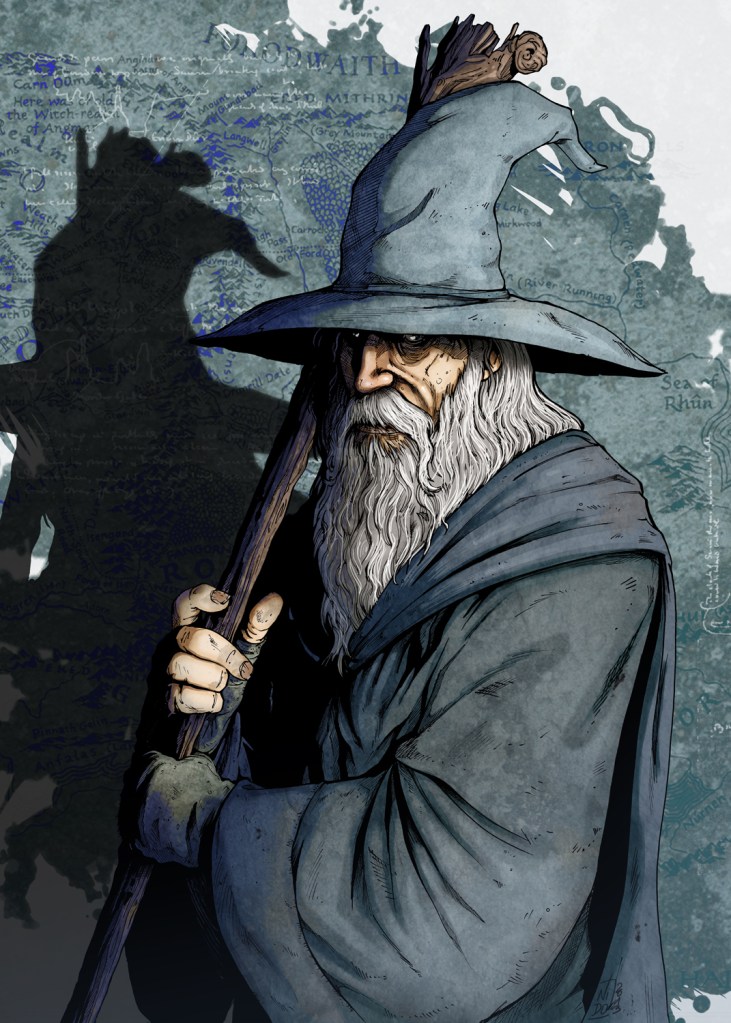
Gandalf, as a character, is defined by his humility. He makes no great show of power except in moments of extreme need and to benefit others. However, in The Hobbit and the early chapter of LotR, he is seen to exercise some small amount of magic while smoking, it is precisely in this context that Bilbo catches just a glimpse of Gandalf’s true nature.
I love the moment, following the unexpected dinner party with the dwarves, when Bilbo enters the drawing room to find Thorin and Gandalf blowing smoke rings. Gandalf’s rings zip around catching Thorin’s, and then they come back and settle in a greenish light above Gandalf’s head. The effect, Bilbo thinks, makes the wizard “look strange and sorcerous.”
Sorcery in Tolkien’s work is usually a word reserved for the evil powers, but here I think it has the effect of highlighting the fact that Gandalf is otherworldly, powerful, and dangerous even while engaging in so homely an act as blowing smoke rings. These sorts of glimpses into the reality of someone else’s being happen frequently in Tolkien’s works (witness, the many glimpses Frodo has of Aragorn as great king and not a weary ranger).
We see also in LotR that Gandalf seems to grow taller and more menacing when chiding Bilbo for accusing him of desiring the Ring for himself. This is another window into Gandalf’s true nature, and Bilbo is cowed in the face of it.
All of this serves to remind his that Gandalf is more than he presents himself to be. “Wizards after all are wizards” is an epic understatement, but Gandalf’s very nature is to veil himself and to guide others to discover their true strength. The threat of his power is there, but he never uses it save at moments of great need.
Gandalf—indeed, all the wizards—appear as old men, somewhat weak and frail but wizened by many long years. For beings of such power, this act of veiling their true nature is an essential act of humility, even if Saruman later rejects all show of humility to exert power.
In the passage on the Istari included in Unfinished Tales, Tolkien tells a few key things:
- They are emissaries from the Valar, the Lords of the West
- They are sent with the consent of Eru Iluvatar, the One God
- They take the bodies of Men, “real and not feigned”
- They are members of the “high order” of the Valar
- Because they have real bodies, they can suffer real physical pains
It has not escaped notice that this description hints rather pointedly at the Incarnation of Jesus Christ in latter days, and that like the Istari, Jesus’ Incarnation is an act of humility, taking on flesh and being subject to the pains and sufferings of this mortal world. Like Jesus, Gandalf is a pilgrim (a wanderer) who calls no earthly place his home—unlike the other Istari, who all settle down to a place.
Christopher Tolkien presents an outline of some hasty notes of his father that Olorin (Gandalf’s true name) was Manwe’s choice (the Lord of the Valar) to go into Middle-earth and that Varda (Manwe’s wife) strongly seemed to hint that Olorin should not go “as the third”—that she meant for Olorin/Gandalf to be the head of the Istari is suggested by Curumo’s (that is, Saruman’s) response: “and Curumo remembered it.” Curumo’s pride claims for himself the highest place; Olorin’s humility initially means he is unwilling to go at all into Middle-earth as he claims “he was too weak for such a task, and that he feared Sauron.” It is precisely the humility inherent in this self-awareness that makes Olorin the greatest and Varda’s choice to lead the Istari—and precisely the reason why Olorin/Gandalf allows Curumo/Saruman to take the lead instead.
Another passage on the Istari points out that Cirdan the Shipwright, one of the bearers of the three Elf Rings, recognised in Gandalf that though he came last of the five Istari, he was the greatest. Olorin’s deep humility again marks him as the greatest of his order—who are sent, after all, as servants—and because of this, Cirdan gives his Ring to Gandalf, thus making him also a ringbearer in Middle-Earth.
We are told also that Gandalf/Olorin is the only one of the Istari who remained faithful to their mission: Saruman (Curumo) fell into evil through pride, Radagast came to love birds and beasts over Elves and Men, and the two blue wizards disappeared into the East.
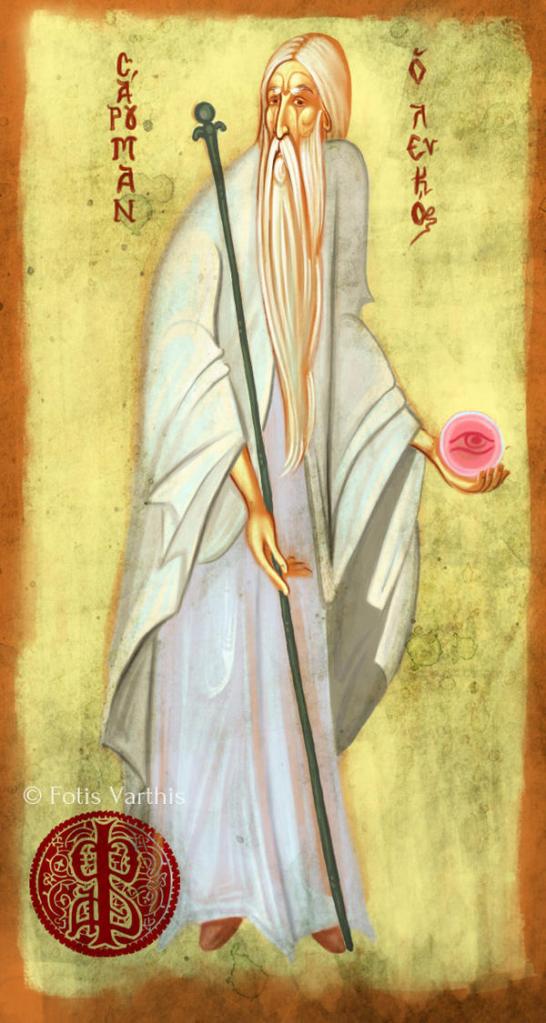
From all outward appearance, Saruman/Curumo is the chief of this order—Gandalf says so himself—but Cirdan, who “saw further and deeper than any other in Middle-earth” could see the deeper reality, that Olorin’s humility marked him as the greatest.
That Gandalf never uses his power to exert dominance—resisting the Ring when Frodo offers it to him precisely because it would cause him to seek dominance even for good—is the sharpest contrast between himself and both Sauron and Saruman.
Finally, in another Christological parallel, Gandalf’s death following the greatest display of his power in the lengendarium, is a death of sacrifice behalf of others. Saruman’s death, by contrast, comes at the end of a long fall from grace due to the exertion of power on behalf of himself.
That Gandalf comes back glorified and in power is sometimes read as Tolkien’s great mistake (though there no evidence that Tolkien thought this way himself), but the wizard’s return is a necessary end to the point that has been Olorin’s entire existence: as Christ says, “whoever exalts himself will be humbled, and whoever humbles himself will be exalted.” Gandalf’s glorification is a deeply Christian result of his sacrificial death, and as such is more true than if Gandalf had stayed dead, as most modern storytellers would have left him.
 Something Tookish
Leave a comment