As the Fellowship is travelling south down the River Anduin, they come upon the towering statues of the Argonath, their massive arms and hands held up in silent warning. As Frodo looks at Aragorn who is looking at the “kings of old,” Frodo has a sort of vision:

"The Argonath" by John HoweFrodo turned and saw Strider, and yet not Strider; for the weatherworn Ranger was no longer there. In the stern sat Aragorn son of Arathorn, proud and erect, guiding the boat with skilful strokes; his hood was cast back, and his dark hair was blowing in the wind, a light was in his eyes: a king returning from exile to his own land. (Fellowship 2.9)
This is not the only time Frodo sees Aragorn as his true self, nor is it the only time that something like this happens in Tolkien’s mythology. Bilbo sees something similar in Thorin when they arrive in Lake-town in Chapter 10 of The Hobbit:
“Thorin son of Train son of Thror King under the Mountain!” said the dwarf in a loud voice, and he looked it, in spite of his torn clothes and draggled hood. The gold gleamed on his neck and waist; his eyes were dark and deep.
In both cases, there is a moment when something deeply true bursts forth in the midst of hardship and darkness. Not all those present see it either; it is rather a kind of special vision given to those with eyes to see.
I wrote two weeks ago about the way Gandalf veils his true nature while walking in the world. While this is a related idea, it is not the same thing that is happening with Aragorn (and Thorin, to a lesser extent). They have not veiled themselves. They have not chosen to descend from the glories of Valinor to the darkness of Middle-earth.
Aragorn rather is humble and lowly by forced circumstance, but as he grows closer to possessing his kingdom the signs of his glory cannot help but leak out. The same with Thorin.
There is an inverse relationship happening here to the kind of veiling that happens for Gandalf: For Gandalf something glorious is hid, but for Aragorn something hid hints at its true glory.
It is interesting how Tolkien uses three characters in Lord of the Rings to represent different aspects of Christ, and I am thinking of this now, for we Orthodox have just celebrated Palm Sunday (yesterday). Gandalf is the prophet; Frodo is the priest; Aragorn is the king.
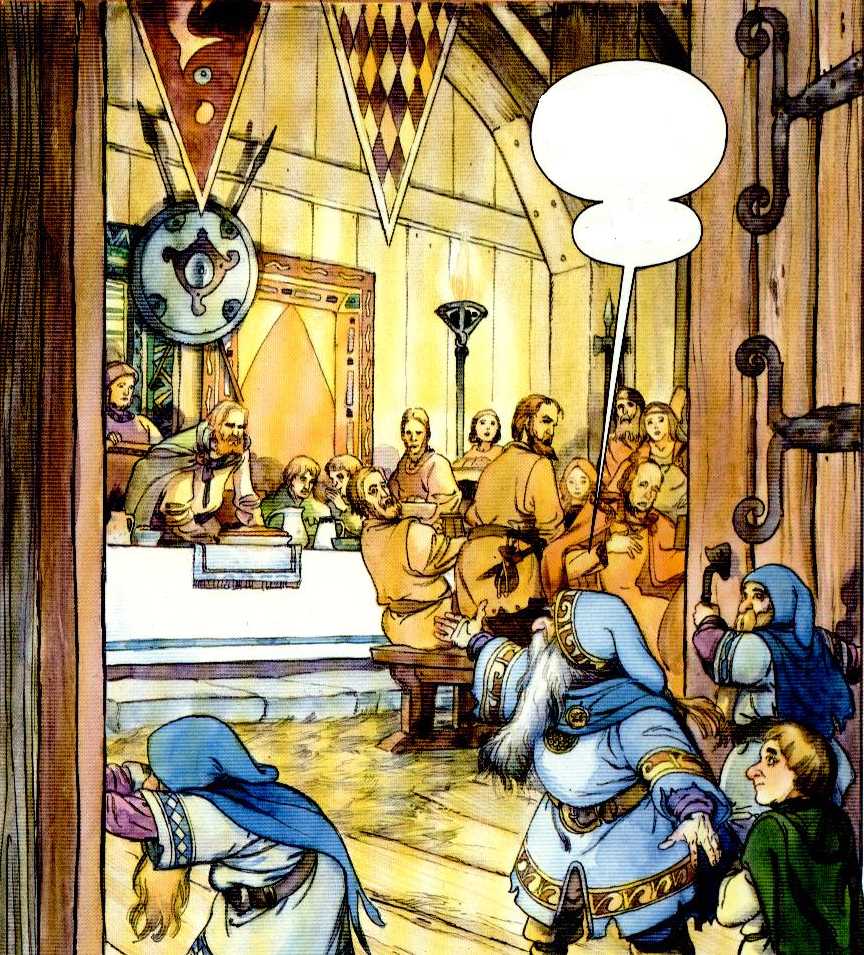
"Thorin in Esgaroth" by David WenzelGandalf shows us Christ veiling himself to enter the world; Frodo shows us Christ’s sacrifice (coming at the end of this Holy Week); Aragorn shows us Christ un-veiling himself in the world as its True King.
Palm Sunday is the day when Christ entered Jerusalem, the ancient city of kings, in the Passover week. Hosanna to the Son of David, the people cried. They saw something that day in the humbly-dressed teacher who rode on a donkey. he was not fully a king yet, but that true nature lay hidden within him about to burst forth in the events of the week to come.
It was a glimpse and nothing more.
Frodo likewise catches a glimpse and nothing more as Aragorn re-enters the ancient realm of Gondor. he is not yet king, not for a long time yet, but for a brief moment he looks like the kings of old.
 Something Tookish
Leave a comment