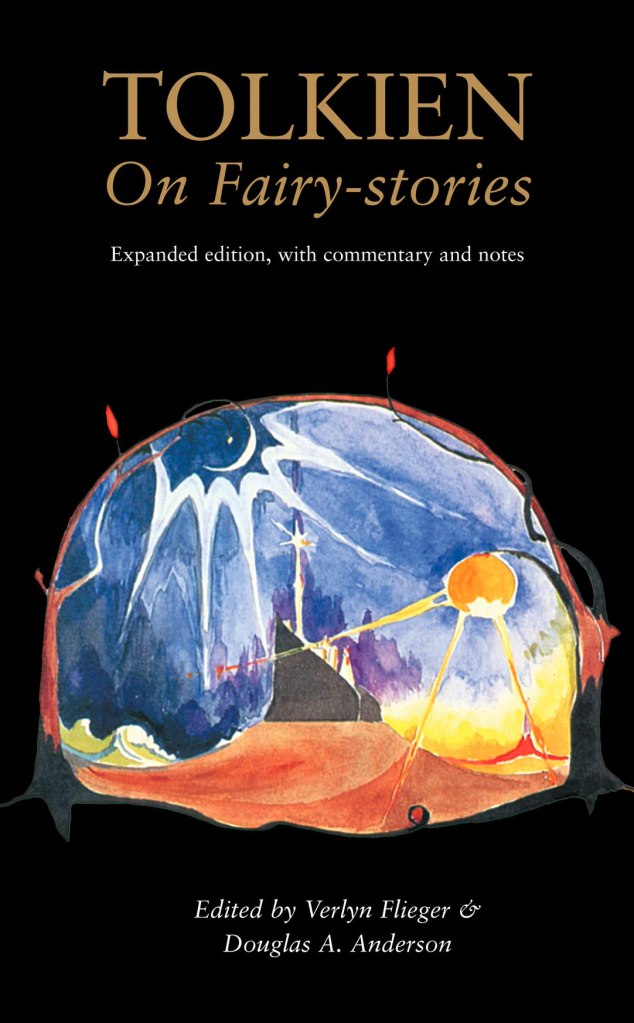
In his essay “On Fairy-Stories,” Tolkien lays out his understanding of how fairytales and all fantasy literature works (or ought to work). There are many ways in which the modern fantasy genre has deviated from this understanding, but then Professor Tolkien was not speaking prescriptively but descriptively.
That is to say that while Tolkien does, in some sense, indicate what he believes should be, he is largely only describing the way fairytales actually are and were up to that point. I am not the first to suggest that he would not be impressed with the modern genre, especially in the trends that have developed since the 90s, but Tolkien was also mostly concerned with traditional stories.
And it is in the style of traditional stories that he wrote. Despite the impact his work had on the modern fantasy genre, I think it is safe to say that he was rather the last of the old style of storyteller rather than the first of a new style.
Now, one of the most important concepts that Tolkien discussed in his essay “On Fairy-Stories,” (and for which he coined the word in English) is his idea of the eucatastrophe.
To set this up, he lays out how fantasy stories function as escapist literature in the best and highest sense. He is defending an entire genre from the barbs and arrows of those who claim that escapist literature is inferior and the stuff of immature minds.
Rather, Professor Tolkien is arguing that what fairytales help us to escape from is hopelessness, which is precisely the malaise that was plaguing Europe in his day (and which continues to haunt the West even now). And fairytales accomplish this escape in a few different ways, the most important of which is through the use of eucatrastrophe.
Tolkien lived in a world defined by catastrophe: World Wars, fascism and totalitarianism, pandemics. On a personal level, he was orphaned, lost all but one of his schoolboy friends in the Great War, and felt the weight of prejudice of a society that was still very anti-Catholic. He could see what the fruits of modernism were, and they were unhappy fruits.
In the midst of this setting, Tolkien coined a new word to describe why fairytales are still needed even in a so-called mature society: eu-catastrophe. The “eu-“ prefix indicates a happy or good catastrophe. That is not to say that the disaster, when it comes, should be welcomed and revelled in—and the disaster still comes despite all of modernity’s claims to have masters the world. No, the idea of a “happy” or “good” catastrophe is that the disaster turns out for the best after all.

"J.R.R. Tolkien portrait" by Donato GiancolaThere is, Tolkien claims, no idealistic I wish the tragedy had not happened at all view in these old stories. Rather, the view is that I am a better person for the tragedy having happened.
And the key lies in how eucatastrophe works. As an example (if the concept is new to you), take the Grimm’s version of Little Red Riding Hood, in which Red and her grandmother are eaten by the wolf. The disaster happens. The worst possible outcome. But the story does not end there. It is only after the wolf has devoured the women and lain down to sleep that the Huntsman find him. He cuts open the wolf and restores Red and Grandmother to life (they had, apparently, been swallowed whole). The wolf is then killed.
The eucatastrophe is the sudden turn towards the good in the face of tragedy. The Hunter does not undo the wrong. Red and Grandmother, though restored to life, were well and truly eaten and will live with the trauma of that experience to the end of their days. But the joy comes in making it through the tragedy and learning from the experience. Red will never again disobey her mother; that much is certain.
The eucatastrophe offers hope. We too often feel like the wolf is eating us all every single day. The stories offer the hope that even in the midst of the tragedy of existence, there is hope that things will be set right. It is not the blind, childish hope that bad things won’t happen. It is the mature hope that we can weather the storm and come through. It is the hope that there is such a thing as real justice in the world.
For Tolkien, the greatest and highest eucatastrophe is the Christian story:
I would venture to say that approaching the Christian Story from this direction, it has long been my feeling (a joyous feeling) that God redeemed the corrupt making-creatures, men, in a way fitting to this aspect, as to others, of their strange nature…. The Birth of Christ is the Eucatastrophe of Man’s history. The Resurrection is the Eucatastrophe of the story of the Incarnation.
The logic seems to be this: The story of humanity is one of a descent. Every new advance promises life and happiness but is almost always twisted and corrupted into a cause of fresh sorrow and injustice. Recall that Tolkien was looking at the fruits of modernism in his own day, that the world had finally thrown off the old superstitions and that an era of science was come to fix all our problems. Those in power tried to fix those problems through war and death—and to be sure, there was plenty of death being dealt by all sides, the Allies were as guilty of it as the Axis powers.
In the age of Rome, God determined that the iniquity—the tragedy—of Men had come to full flower, and at this moment when judgment loomed and a catastrophe of our own making was about to overwhelm our race, God acted. He entered history, entered His own creation. That is what Tolkien means by calling the Birth of Christ the “eucatastrophe of Men’s history.”
And in the Orthodox Church, we celebrated yesterday the “eucatastrophe of the story of the Incarnation” in the Resurrection of Christ. That this is a eucatastrophe is clearly seen in the story: Christ is arrested, tried, and executed unjustly. This is the catastrophe of the Incarnation.

Icon of the ResurrectionBut then Christ uses that death to trample down death. He wins a great victory over the foes of mankind. His coming, his Resurrection, like Red Riding Hood’s does not erase the evil that was done, but it redeems it, gives it meaning, shows us the hope that lies in the world.
It is for this reason that Tolkien could not abide the pessimism and nihilism of his age. These are philosophies and ideologies of hopelessness. It is that lack of hope that has led “serious adults” to abandon the escapism of fairytales. It is that lack of hope that has led writers after Tolkien to abandon the escapism of fantasy.
George RR Martin’s A Game of Thrones and the rest of that series offer no eucatastrophe. These are hopeless stories that mirror too much the horrors of our world without suggesting that there is any meaning in suffering beyond what power and dominance we can assert over others.
In that sense, Martin’s novels and others like them could be called “fantasy” by those who stock bookstores, but they are hardly fantasy in the sense that anyone before our time would have recognised. This is not to say that there aren’t good works being published, only that they do not line up with the classical genre.
Like so much in the modern world, people have tried to reinvent the wheel, and in while they may have gained by so doing, they have lost the soul of the thing that existed before. This is why so many of the modern Disney remakes have failed. There may be outdated values in the old stories, but by trying to remake pre-modern stories and genres as modern ones, the very life is torn out and a hollow but politically-correct shell remains.
The Gospel story, like all true fairytales, is not a politically-correct story because the world is not a politically-correct place. We cannot brush over the ugliness of the world by using nice, inoffensive language and pretending that the catastrophe doesn’t exist. Neither is the way forward a full embrace of catastrophe as the brute reality of being.
Tolkien offers the third way, the way of the fairy-story, the way of eucatastrophe, of disaster redeemed. All true stories are ultimately stories about Christ because that is the ultimate story of humanity. All of our joys and our tragedies are wrapped up in it.
For the Art of it has the supremely convincing tone of Primary Art, that is, of Creation. To reject it leads either to sadness or to wrath.
 Something Tookish
Leave a comment