After taking a little break, I have begun reading The Lord of the Rings aloud to my wife and daughter again. We picked up in Fangorn forest, and just this weekend I read to them of the healing of Theoden. It is one of those passages that I am surprised by time and again because the film version is the primary memory I have of it and yet the film version is so very different from the book. Peter Jackson presents Theoden’s healing as a kind of exorcism, but that is not at all what happens in the original.
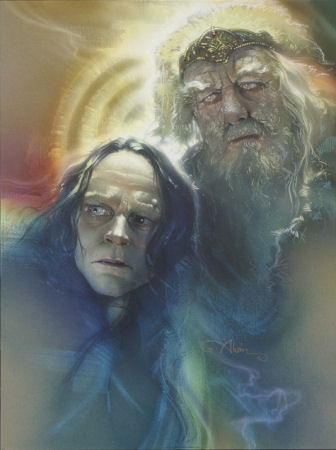
"Theoden and Wormtongue" but John AlvinIn fact, I find it a little bit difficult to pin down exactly what happens in Tolkien’s telling, which perhaps is what led to the film’s more dramatic version. The book is, well, a bit ordinary by comparison, at least on the surface of things.
When Gandalf first greets Theoden, the king is rather blunt in declaring his pleasure at hearing of Gandalf’s fall to death in Moria. He seems to have little love for the wizard. Theoden is old, leaning heavily upon a short black staff and bent over with years, though it is apparent that he must have been a powerful young man at one time. He calls Gandalf “Stormcrow” to indicate that he thinks the wizard is merely the bearer of bad news, never bringing aid and always asking for it.
At this moment we are introduced to Grima Wormtongue, the pale man sitting upon the steps of the king’s dais. There is an exchange of words between Gandalf and Grima that goes on for some time, far longer than in the film, and ends with Gandalf singing a hymn in honour of Galadriel, the Lady of Light. The upshot of it all is—if we are looking for an exorcism moment—Gandalf declares, “I have not passed through fire and death to bandy crooked words with a serving-man till the lightning falls.”
Gandalf then raises his staff: There was a roll of thunder. The sunlight was blotted out from the eastern windows; the whole hall became suddenly dark as night. The fire faded to sullen embers. Only Gandalf could be seen, standing white and tall before the blackened hearth. In the gloom they heard the hiss of Wormtongue’s voice: “Did I not counsel you, lord, to forbid his staff? That fool, Hama, has betrayed us!” There was a flash as if lightning had cloven the roof. Then all was silent. Wormtongue sprawled on his face.
That is it. From this moment, Theoden begins to heal, not nearly as quickly as in the film, but in steps over the course of the rest of the scene. There is no Saruman with his powerful magic lurking in the background, only the more “mundane magic” of Wormtongue’s worm-tongue.
So what happens here?
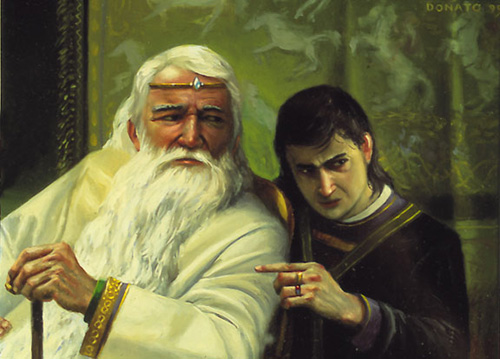
"Persuasive Words" by Donato GiancolaIf there is an exorcism, it is not an exorcism of Saruman in his tower, looking through a Palantir. It is the casting out of Wormtongue’s own lies, the breaking of the web of half-truths and untruths than has Theoden bound in despair.
Gandalf entered the hall clothed in his grey travel robes, but he casts off that tattered cloak as he finishes his song about Galadriel, revealing the bright white underneath that had so dazzled Aragorn, Legolas, and Gimli in Fangorn. He does not glow exactly, but as the whole hall falls into darkness, Gandalf is the only one who remains seen, so there is a kind of light about him.
What Gandalf is doing here in casting the hall into darkness is making real and physical what is real and true in Theoden’s mind: The king is bound in darkness by lies that cause him to not be able to see hope in the world. Gandalf cloaks the hall in darkness as a sign that this is how the king has lived but that he, Gandalf, comes to reveal the truth that there is something to hope in. And Wormtongue cannot abide the light. He calls out and is struck by light as if in judgment.
Two thoughts occur here: firstly, the flashing light is not lightning exactly but is described as a “flash as if lightning had cloven the roof.” What is this flash? It is the light of truth bursting into the darkness that has taken over Theoden’s hall. The king’s mind is so darkened by Wormtongue’s lies that the truth is blinding for a moment. The liar cannot continue to stand in the presence of the truth and so sprawls to the floor, hiding his face. The king, however, is healed as the darkness begins to recede.
The second thing that occurs to me is how effective Wormtongue’s lies were. There is no magic here other than the magic that Gandalf brings, and yet Wormtongue has managed to convince the king that he is a decrepit old man who cannot do much for himself, that he is failing just as the world—as Rohan—is failing.
Gandalf now tells the king, “Too long have you sat in shadows and trusted to twisted tales and crooked promptings.” The sickness Theoden suffered was a sickness of the soul. A bit further on, the wizard says, “Nor does age lie so heavily on your shoulders as some would have you think. Cast aside your prop!” And the king lets go his walking stick and stands up straight.
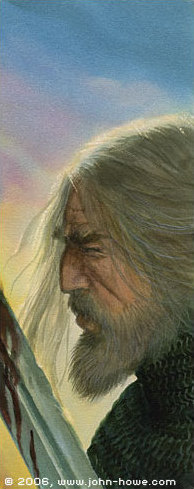
"Theoden" by John HoweIt’s not hard to imagine why Jackson went with the image of an exorcism, for there is clearly something deeply spiritual about this passage. At one point, Theoden smiles and as he did so many lines of care were smoothed away and did not return.
The king has suffered a spiritual sickness, a sickness of hopelessness that has caused him to manifest outwardly all the fears and terrors lurking within. Those fears were planted by Wormtongue. It is not from nowhere, of course, that Jackson got the idea of a Sarumanic possession, for we learn in succeeding chapters that Wormtongue is a creature of Saruman’s, but the truth that this passage reveals is that it is hardly necessary to explain a sickness of the spirit by great magic. It is something that is common to all, and easily foisted upon us when we open ourselves to bad counsel.
Theoden’s healing is really a return of hope. His world is a world of darkness and despair when we first meet him. As such, Gandalf’s presence is blinding—like the sun in Plato’s Cave Allegory, Gandalf as truth is so powerful that some cannot look upon it. For others, it finally clears away the shadows and shows the world as it is—the bad, yes, but also the good. The great lie is that all the world is evil, all people are evil (or at least are acting evil and therefore cannot be trusted, cannot be hoped in).
The king’s shadows being driven off allows for hope to creep back in. The healing takes place in stages, though. First the physical body recovers: he walks outside—into the light of the sun!—and throws aside his walking stick; then a smile chases away lines on his face; finally, Gandalf tells the king to take up a sword, allowing his body to complete its healing.
But Theoden has now got to deal with the repercussions of his darkness, for as king his hopelessness has had an effect on his people. Even as he is in the process of physical healing, he is confronted with Eomer’s apparent disloyalty and has to deal with his nephew, whom he had previously cast into prison.
It is of the utmost importance that the first sword Theoden grasps is Eomer’s, offered in service, rather than the king’s own sword (as it is in the film). This moment when the king returns to his full strength is accompanied by re-union with his family, who have suffered as much from the king’s own sickness as the king has. Like the darkness Gandalf brought on the hall earlier, Theoden’s taking up of Eomer’s sword symbolises outwardly the inner state of the king.
If Theoden takes his own sword, then it is a sword of judgment and the weapon of his own strength. But in taking his nephew’s sword, it is a sword of reconciliation: Theoden is reconciled to himself and to the world. True reconciliation is always two-sided. There is always a reconciliation to the self and to the other.
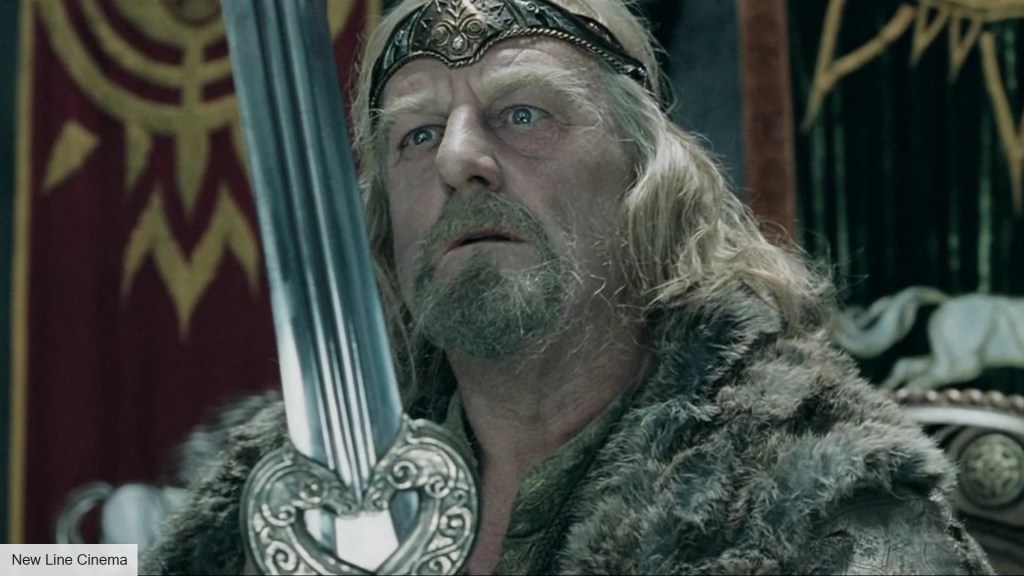
Bernard Hill as TheodenAnd reconciliation is healing. The words mean basically the same thing: To reconcile means to restore, bringing together what has been split apart; to heal means to make whole. The concepts are identical.
So what exactly happens to Theoden? If the scene of Theoden’s healing is not really as Peter Jackson tells it, what is the nature of Theoden’s healing?
It’s definitely a kind of exorcism, for the demon of despair held sway in the king’s heart. Theoden is reconciled to the truth of the world as it is. Gandalf is showing that there is hope after all. Theoden’s sickness is a kind of nihilism, a sense that nothing the good do will matter; we are all just awaiting our doom. But Theoden is reconciled, healed, by seeing through the darkness to the light of hope.
It is not the cheap, ordinary, everyday hope that we have of the sun’s rising on a fair day rather than a stormy one. It is the deep, motivating hope that gives one the power to act decisively in the world despite not knowing how things will turn out.
 Something Tookish
Leave a comment